2025 in Review: Making ClearSKY More Flexible
2026-01-02 · 4 min read · Company Update · Product · Dashboard · API · 2025 Review
2025 was a rebuild year at ClearSKY. The goal was not just to ship features, it was to make ClearSKY easier to use, more flexible in how you order, stronger globally, and more affordable as we roll out newer models. At the same time, we kept producing near real time cloud free fused imagery throughout 2025, across multiple countries, for customers who rely on frequent updates. We did not pause the service to rebuild it, we rebuilt while operating.
The reason we keep iterating is simple. Near real time data fusion is difficult. Getting consistent quality across geographies, seasons, and sensor availability is hard, and the bar for delivery speed keeps moving. We keep pushing what is possible in model performance, and what is possible in end to end delivery time. A lot of the work in 2025 was deep in the plumbing, faster pipelines, better processing, and higher reliability. That foundation is what makes everything else possible, faster delivery, less friction, and a product you can scale operationally.
Flexibility and ease of use, the dashboard launch
In 2025 we built and launched the ClearSKY Dashboard. Most of what customers could already do through the API is now available in the UI, so teams can place orders, estimate costs, and download deliveries without building internal tooling first.
Key improvements:
- Order cost estimation for polygons and tiles
- A multi order cart for placing and managing several orders
- Past orders and history, including status and metadata
- Downloads for a single image or a full time series
- A smoother workflow from polygon to delivery
Ordering improvements in the API
We also expanded the API to make ordering simpler and more robust across different workflows.
Ordering and operations:
- Endpoints for more detailed order details
- Endpoints that return an optimized set of minitiles and tiles based on a WKT or GeoJSON geometry, so it is easier to get the right coverage in all cases
Billing and usage insight:
- Billing summary endpoints
- Itemized lists for all orders
- More insight into credit usage, history, and trends
These changes sound small, but they reduce friction a lot when ordering becomes frequent, when geometries get complex, or when multiple people and teams touch the same account.
New websites and tooling, clearer onboarding and fewer mistakes
We rebuilt www.clearsky.vision to make the product easier to understand and easier to evaluate. Clearer pages, faster navigation, and a better path from first visit to first order.
We also improved docs.clearsky.vision with more examples and more practical content. The goal is that you can copy a working example, adapt it, and ship, without guessing how to structure orders or how to handle edge cases.
On top of that, we launched a set of small focused tools that reduce friction in real workflows:
- polygon.clearsky.vision, a polygon editor and converter built to help users fix, validate, and prepare polygons before submitting an order
- tiles.clearsky.vision, a small tool to compare ClearSKY tiles to Sentinel 2 tiles, useful when you are moving between standard tiling and ClearSKY ordering
Scale and reliability, what the rebuild enabled
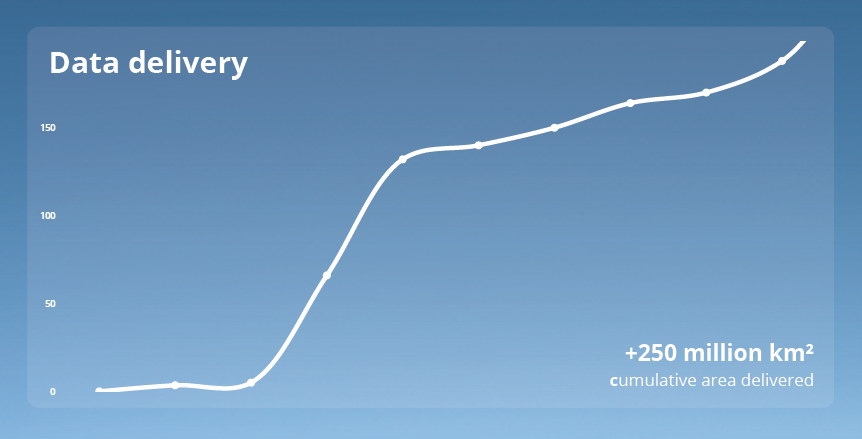
One delivery number we are proud of is 250+ million km² delivered to customers in 2025. Behind that, we processed more than 400k satellite products to deliver the imagery.
This is the kind of scale where reliability and automation matter more than anything, and it is why we spent so much effort on rebuilding the foundation while continuing near real time production.
A tailwind, stronger SAR availability
Sentinel 1 returning to two operational satellites was a real boost. More SAR capacity helps resilience when optical is limited, and it improves global reliability.
Focus for 2026, next gen models and global scaling
The focus for 2026 is shipping next gen, globally scalable models, and adding more satellites and sources to increase coverage and resilience.
We will keep pushing on near real time performance, delivery speed, and product ergonomics, because that is what makes ClearSKY easier to adopt and easier to run at scale.